What a Price Per Square Foot Really Tells You in Bay Colony
July 16, 2026
July 16, 2026
The obvious story about Bay Colony is the one every portal repeats: a guard-gated enclave of roughly 108 waterfront homes, deep canals behind each lot, an average sale price in the high three millions. The obvious story is not wrong. It is simply not useful, because it hides the number that actually decides a Bay Colony transaction.
That number is the price-per-square-foot spread. In a single trailing-year window, three closed sales inside this one gated community printed at $490, $858, and $1,085 per square foot under air. Same gate. Same water. Same bridge-free run to the Atlantic. More than a 2x range on the metric buyers use to sanity-check every other line in the deal. If you are shopping Bay Colony against Harbor Beach, Rio Vista, or the Landings and reading only the median, you are reading the wrong number.
Bay Colony traded nine homes in the twelve months ending July 2026, with an average asking price of $4,722,643 and an average sale price of $3,856,431. That $866,000 gap between ask and sale is itself a signal, but the more instructive figure is how those closings sorted internally.
| Sale vintage | Approx. size (SF under air) | Price per SF |
|---|---|---|
| 1970 original | 6,122 | $490 |
| 1988 renovated | 10,000+ | $858 |
| 2019 new construction | 10,000+ | $1,085 |
A buyer who anchors on the community average of roughly $630 per foot will overpay for a 1970 house and severely underbid a 2019 build. Neither offer reflects the market. The market inside these gates is not a single price. It is three distinct sub-markets stacked on the same 108 lots, and the sub-market a given house belongs to is set the day the roof goes on.
Bay Colony was substantially completed in the early 1970s. The neighborhood is now what appraisers politely call a regeneration market, meaning almost every current listing is either an Addison Mizner Mediterranean original that has been gut-renovated, a 1980s or 1990s tear-through, or a full contemporary rebuild on the original lot. The three vintages sit side by side and are marketed with the same aerial photograph.
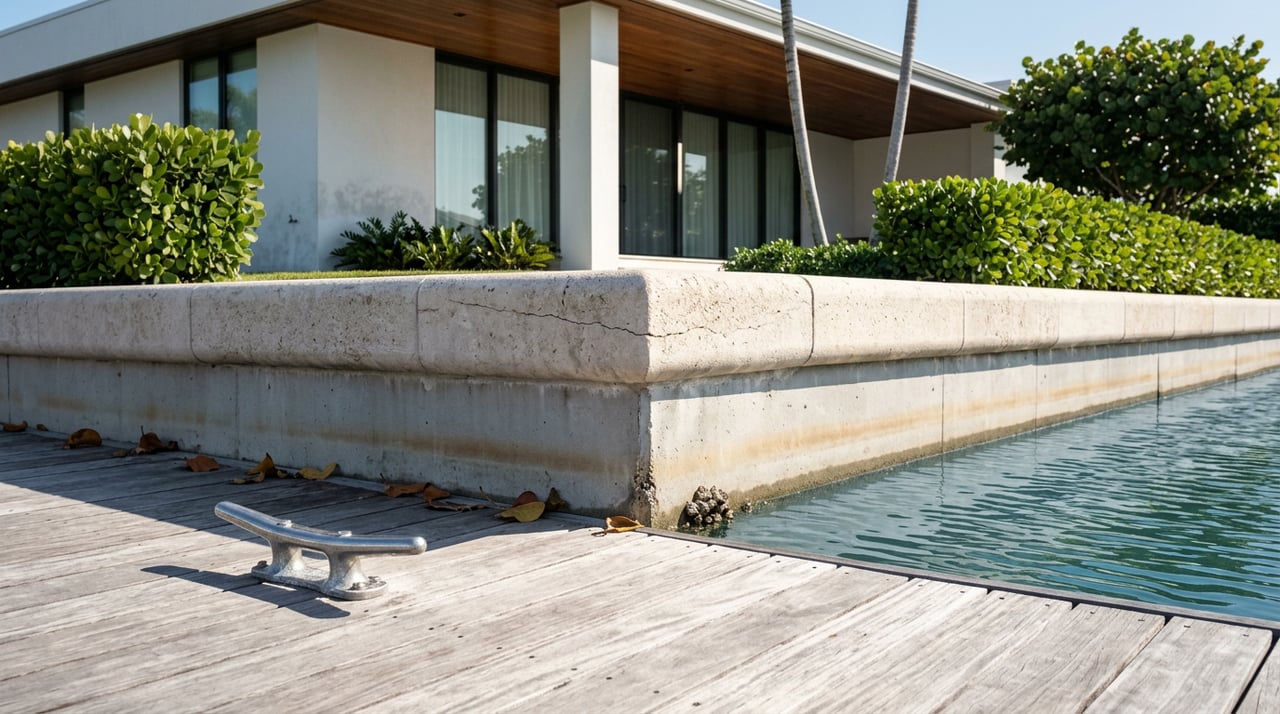
They do not carry the same cost basis, and they do not carry the same insurance profile. A 1970 concrete-block house with an original roof structure, single-pane openings, and a first-generation seawall is a different underwriting risk from a 2019 build engineered to current Florida Building Code with impact glass and a rebuilt bulkhead. That difference shows up in the wind and flood premium the buyer inherits at closing, and it shows up again on resale. The $490-per-foot house is not a bargain relative to the $1,085-per-foot house. It is a construction project priced as one.
The practical read for buyers: ask when the seawall was last replaced or capped, when the roof was last permitted, and whether impact glazing runs on every opening or only the front elevation. Those three answers move the per-foot number more than kitchen finishes ever will.
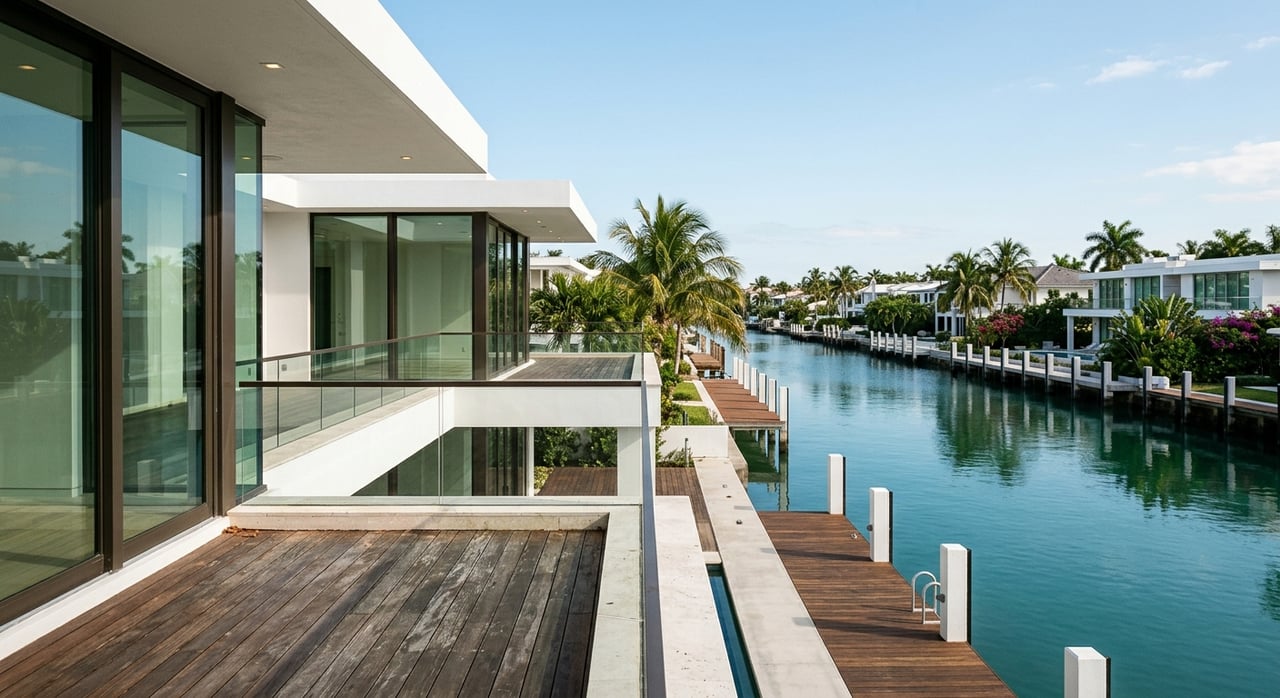
The second variable stacked on top of vintage is the water itself. All Bay Colony lots carry deep-water canal frontage with dock capacity up to roughly 100 feet, and the neighborhood sits north of the 17th Street Causeway, which is the principal fixed-bridge constraint shaping large-vessel siting in Fort Lauderdale. That geography is worth money.
Waterfront in this market typically commands 40 to 70 percent over comparable inland square footage, with Intracoastal frontage stretching that premium to 80 to 120 percent. Within the waterfront category, deep water combined with wide canals and unrestricted ocean access carries an additional 15 to 25 percent over non-boating waterfront. Bay Colony qualifies on every count, which is why the floor on any renovated Bay Colony sale rarely dips below the mid seven figures regardless of finish level.
That said, not every Bay Colony dock is interchangeable. Canal width, turning-basin geometry, dock configuration, and the position of the lot relative to the community's interior canal loops all affect what vessel a specific address can actually accommodate. Two homes on the same street, at the same per-foot price, may support very different boats. A buyer whose calculus depends on a specific yacht should measure beam and draft against the individual slip before writing the offer, not after inspection.
Sellers, the mirror image applies. A dock that comfortably handles an 80-foot vessel is not a footnote in the listing description. It is a pricing input, and it belongs on the first line of the remarks.
One transaction-specific friction catches out-of-market buyers with startling regularity. Bay Colony, the single-family enclave, is not the same as Bay Colony Club, the adjacent condominium community. They share a name, they share a general zip code, and they show up in the same MLS searches. They do not share a market.
Bay Colony Club units currently list in the low-to-mid six figures. A one-bedroom recently priced at $260,000. Those closings pull into any automated comp report keyed to the words "Bay Colony," and they drag the reported neighborhood median down by an order of magnitude. If a broker's price opinion on your target single-family home includes any Bay Colony Club transactions in the comp set, the analysis is broken. Ask for the raw comp list, confirm every entry is a single-family residence inside the gated section, and rebuild the average from there. This one filter has moved offers by seven figures in past transactions.
The mid-funnel takeaway is not that Bay Colony is expensive or inexpensive. It is that the community's headline statistics compress three separate markets into one number, and the buyer or seller who works from the headline is negotiating against a fiction. A defensible Bay Colony valuation isolates vintage, isolates dock geometry, and excludes Bay Colony Club from the comp set entirely. Do those three things and the per-foot number stops swinging.
For buyers relocating from the Northeast or from international markets, the deeper point is that Bay Colony is not a substitute for Harbor Beach and not a discount version of it. It is a smaller, older, quieter product with a different construction spread and a materially different entry point at the bottom of the range. Those attributes suit a specific buyer. Reading the median tells you nothing about whether that buyer is you.
How many Bay Colony homes typically sell in a year? The community closed nine single-family sales in the trailing twelve months ending July 2026. With only 108 total homes and long ownership tenure, transaction volume is thin, which means one outlier sale can move the reported average materially in either direction. Read the individual closings, not the aggregate.
Is a 1970s original in Bay Colony a value play or a construction project? Treat it as a construction project priced at land plus a partial improvement. The last $490-per-foot sale reflected that reality. If your renovation budget and timeline are honest, the arithmetic can work. If they are optimistic, the finished per-foot cost will land above what a comparable 2019 build would have cost you outright.
Does no-fixed-bridge access alone justify the premium? It removes the height constraint, but height is one variable among several. Channel depth at low tide, canal width for maneuvering, and turning-basin geometry on your specific route to Port Everglades or Hillsboro Inlet all need independent verification for the vessel you actually own or plan to buy. The phrase is a filter, not a guarantee.
What's the single biggest mistake out-of-market buyers make here? Anchoring on comps that include Bay Colony Club condominium sales. The name overlap pulls automated comp reports into unusable territory. Rebuild the comp set by hand, single-family only, inside the gate.
If you are weighing Bay Colony against Harbor Beach, Rio Vista, the Landings, or an oceanfront tower, the right first step is a comp review built by hand rather than by algorithm. Florida Castles prepares private, address-specific valuations that isolate vintage, dock geometry, and route-to-inlet from the headline median, so the number you negotiate against is the number that actually applies. Request a private consultation and personalized market review to see what your target address is genuinely worth in this cycle.

What Buyers and Sellers Need to Know About the Fort Lauderdale Real Estate Market Right Now.

A Complete Guide to Preparing to Sell Your Home in Fort Lauderdale Before the Sign Goes Up.
A Seller's Guide to the Home Selling Process in Fort Lauderdale From Contract to Close.

What Sellers Need to Understand About Buyer Psychology When Selling Your Home in Fort Lauderdale.
If you are relocating to South Florida, let me know the needs of your ideal real estate purchase, and my team and I will conduct in-depth market research to prepare the properties for your viewing upon arrival or virtual showing.