Why July Nights on Hillsboro Mile Belong to the Turtles
July 9, 2026
July 9, 2026
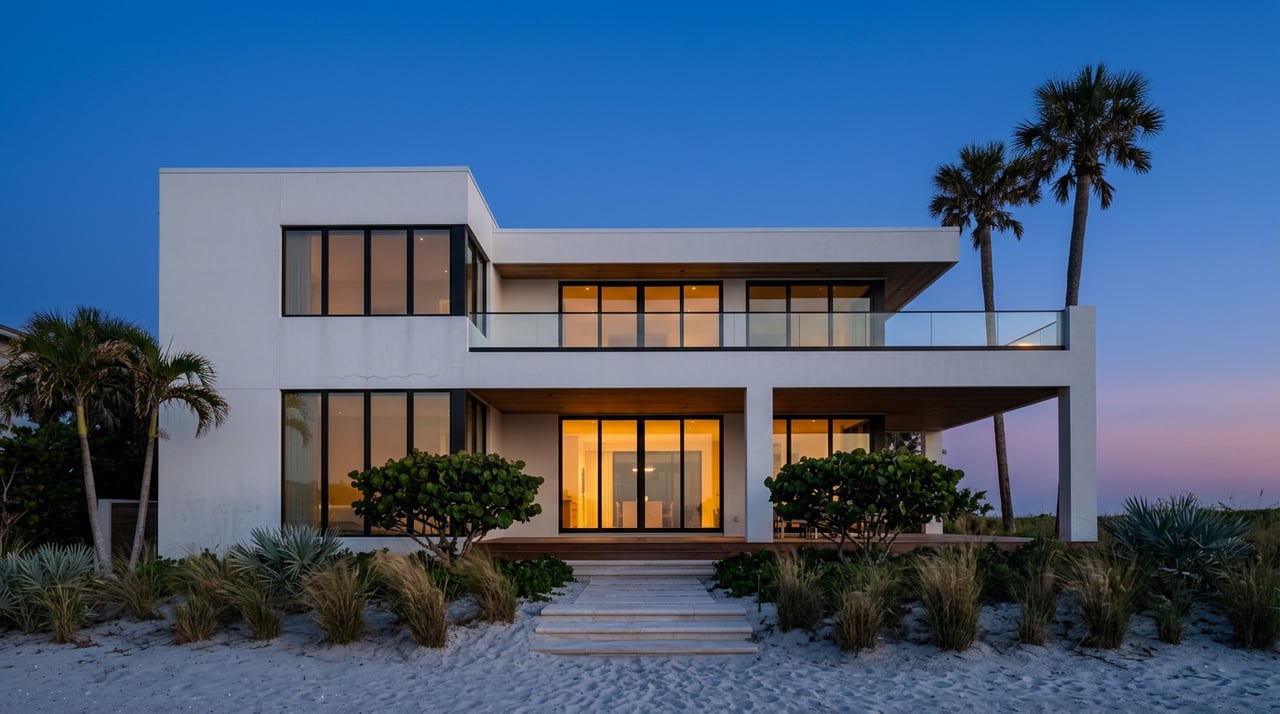
Step outside on Hillsboro Mile after ten o'clock in July and the first thing you notice is what you cannot see. A1A stretches without a single street light. Windows on the ocean side glow amber, if at all. The Atlantic is louder than any car. This is not a power outage or a design oversight. It is the point of the town, and July is the month the reason becomes unmistakable.
Every homeowner along this 3.2-mile barrier island is, whether they know it or not, part of one of the most productive sea turtle nesting corridors on Florida's East Coast. The town says so plainly: Hillsboro Beach has one of the highest densities-per-mile for sea turtle nests along the East Coast of Florida, the season officially runs March 1 through October 31, and the town hosts Leatherbacks, Loggerheads, and Green sea turtles. What that means on the ground, in the week of the Fourth of July, is that your back terrace is closer to a nursery than to a nightclub, and the town's whole regulatory posture has been engineered accordingly.
Newcomers driving A1A for the first time often assume the town simply forgot to finish itself. There is no commercial strip. There are no schools within town limits. There is one road, and it is dark. The town sits on a 3.2-mile-long barrier island along State Road A1A, feels intentionally edited with one roadway running its full length, and reads as almost entirely residential, a simplicity that is the point. The dark road is part of that editing. The town's character and policies include the well-known absence of street lights, a choice tied to preserving sea turtle nesting.
The reasoning is not sentimental. It is biological, and it is codified. Florida requires coastal municipalities to control beachfront lighting under Section 161.163, Florida Statutes, which directs the Florida Department of Environmental Protection to designate coastal nesting areas and set guidelines for local regulations controlling beachfront lighting to protect hatching sea turtles. Hillsboro Beach has one of the stricter local versions. Its municipal code prohibits, from sunset to sunrise during nesting season, most motorized vehicles on the beach and any transient lighting that purposely illuminates nesting sea turtles or hatchlings, with exceptions only for permitted conservation and research personnel. The town also enforces the rules with feet on the sand: periodic nighttime lighting inspections are performed from the beach during nesting season to determine compliance, and these inspections continue until existing beachfront lighting has been brought into line.
If your neighbor's landscape uplights suddenly disappeared last spring, this is why.
Residents who have only ever seen the beach in winter tend to think of turtle season as a long, uniform stretch. It is not. The July calendar is when the loggerheads compress the whole story into a few weeks.
| Weeks | What's happening on the sand |
|---|---|
| March | Leatherbacks arrive first, largest and rarest of the three |
| April | Loggerheads begin nesting in earnest |
| Late June to early July | Peak loggerhead nesting |
| May through June | Greens start crawling up |
| August through October | Hatchlings emerge, mostly at night |
That schedule is not local folklore. Leatherbacks are the first to arrive in March, followed by the more common Loggerhead in April, then Green Sea Turtles in May and June, with peak Loggerhead season falling in late June into early July. The stretch of A1A you drive to get a gallon of milk is, in these specific weeks, hosting the busiest nights of the year for the species that gives Broward its reputation.
Broward County monitors the outcome carefully. The county has 26 miles of coastline, 24 of which are monitored for turtle nesting by the Broward County Sea Turtle Conservation Program, and the county is considered a medium-density nesting area with an average of 2,000 nests annually. Hillsboro Beach's contribution to that count, relative to its length, is outsized. A three-mile town punches well above its weight because the beach is quiet, the road behind it is dark, and the ordinance has been on the books for decades.
The rule that most affects daily life for oceanfront owners is the lighting standard, and the giveaway is the color. Drive south down A1A in July and the porch lights, pool cages, and landscape fixtures on the ocean side glow the color of a birthday candle rather than a stadium. That is deliberate. Between March and October the only lights near the shoreline are amber-colored, because bright white lights can disorient nesting sea turtles and their hatchlings and lead them away from the ocean rather than toward it, so the coast follows special lighting guidelines to ensure a safe journey.
The town code translates the biology into architecture. Fixtures must be positioned so the point source of light is not visible from the beach. Any accent or decorative lighting counts:
Any "point source of lighting" including, but not limited to, floodlights, up-lights, or spotlights for decorative, recreational and accent purposes shall not be directly visible from the beach during nesting season.
In practice, this means the recessed can lights inside your loggia, the low-voltage path lights along your pool deck, and the wall sconces flanking your beach gate all need to be turtle-code compliant from March through October. Long-time residents plan for it during design. Newer owners tend to discover it the first summer, usually after a knock on the door from a code enforcement officer who has just walked the wet sand behind the house with a clipboard.
There is a small aesthetic benefit that gets undersold. The amber ordinance is what makes a July night on Hillsboro Mile feel the way it does. Moonrise reads properly against the water. Stars are visible from a beach terrace in a way they are not two towns south. It is one of the few oceanfront settings in Broward where you can still see the Milky Way with any confidence.
Somewhere between one and four in the morning, in these specific weeks, other people are on your beach. They have permits, red flashlights, and buckets.
Sea Turtle Oversight Protection, or STOP, was founded in 2007 by the WhiteCloud family and was the first program of its kind to rescue and release sea turtle hatchlings disoriented by coastal lighting in Broward County. Their coverage area is direct: the group rescues disoriented hatchlings and sick or injured juvenile and adult marine turtles across Broward County, including Hillsboro Beach, Deerfield Beach, Pompano, Lauderdale by the Sea, and Fort Lauderdale. The scale is not small. Since 2007, STOP volunteers have bucketed over 280,000 hatchlings that disoriented to lights on Broward County beaches, and by the organization's own accounting the program has reduced the hatchling mortality rate by over 40% in Broward County.
The number worth committing to memory is the emergency line. If you find a stranded hatchling on the beach behind the house, or a disoriented adult on A1A, the town directs residents to call 954.328.0580 for any sea turtle in distress. STOP's own 24-hour line during nesting season is (954) 404-0025. Neither number belongs in a drawer. Program them.
There is also a piece of neighborly etiquette worth knowing. Rescue volunteers work in the dark for a reason. If you see a small group with red-filtered flashlights on the sand at three in the morning, they are not trespassing and they are not lost. They are on a permit walk. The correct response is to keep your terrace lights off and go back to bed.
The daylight version of all this happens at the north end of the Mile, at the Hillsboro Inlet Lighthouse, and it is genuinely difficult to visit unless you know the trick. The trick is that you cannot drive there. The U.S. Coast Guard approves a schedule under which the volunteer preservation society can offer tours several times a year, but only if visitors arrive by boat. Tour boats leave from SFL Dive Headquarters at 125 North Riverside Drive, Pompano Beach, once a month, and the two-mile ride up the Intracoastal offers some sightseeing along the way, with dates and reservations available through the Hillsboro Lighthouse Preservation Society.
The lighthouse itself is worth the effort. It is 175 steps to the top, and the 9-foot clam-shell lens produces the most powerful light of any remaining lighthouse in the United States, visible 28 miles to sea. On the grounds you will find the memorial to the barefoot mailmen, the postal carriers who walked and rowed a 68-mile route between Palm Beach and Miami from 1885 to 1892, one of whom, James E. Hamilton, disappeared while walking the route in 1887 and is presumed to have drowned or been killed trying to swim across Hillsboro Inlet.
Membership in the Hillsboro Lighthouse Preservation Society is one of the better small deals in town: individual dues are $35 and include free tours for a year, with group memberships available at $75 for four and $100 for six, all of which cover guests. Plan the climb for a morning tour, then hold lunch for the historic ride back. Cap's Place, the historic waterfront restaurant nearby, is actually tied to the lighthouse's history: during Prohibition, lighthouse keeper Thomas Knight's brother built a restaurant on a nearby island called Club Unique that served illegal booze brought in by rum-running boats, and it still operates today in its shack-like buildings as Cap's Place. There are not many places in South Florida where you can start the day on a Coast Guard-controlled island and end it at a rum-runner's dining room without leaving a five-mile stretch.
The trade a Hillsboro Mile homeowner makes is not obvious from a listing photograph. You give up the corner store, the streetlight, the white porch light in July. You get, in return, one of the darkest, quietest, most biologically consequential stretches of oceanfront in South Florida, and a July night sky most of the region no longer has access to. The ordinance, the lighthouse, and the volunteers with buckets are not separate stories. They are the same one.
If you own a home on the Mile and want a walk-through of what turtle-season compliance looks like at your specific address, or you are curious how the town's rhythms shape ownership year-round, Florida Castles knows this stretch of coast intimately. Request a private consultation and personalized market review.

What Buyers and Sellers Need to Know About the Fort Lauderdale Real Estate Market Right Now.

A Complete Guide to Preparing to Sell Your Home in Fort Lauderdale Before the Sign Goes Up.

A Seller's Guide to the Home Selling Process in Fort Lauderdale From Contract to Close.

What Sellers Need to Understand About Buyer Psychology When Selling Your Home in Fort Lauderdale.
If you are relocating to South Florida, let me know the needs of your ideal real estate purchase, and my team and I will conduct in-depth market research to prepare the properties for your viewing upon arrival or virtual showing.